What if you could fight a war without risking human lives on the front line?
What if your “first soldier” entering a dangerous room wasn’t a person—but a machine that doesn’t feel fear, fatigue, or hesitation?
That future isn’t coming. It’s already here.
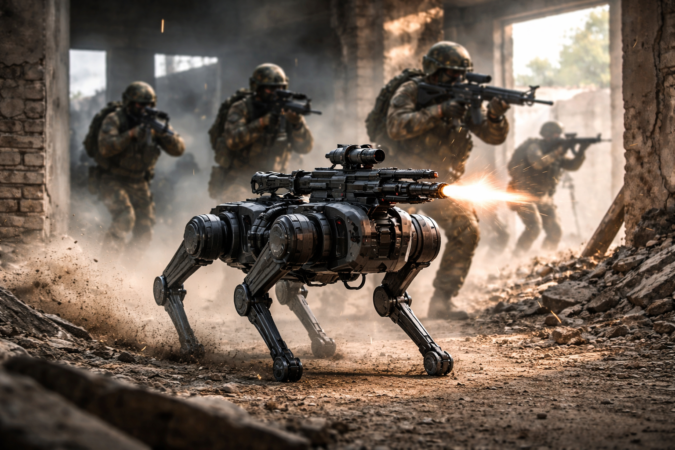
A recent military training clip shows something that feels straight out of a video game—but it’s real. A four-legged robotic unit, armed with a rifle, moves through a simulated combat zone alongside human soldiers. The footage looks like a “kill cam” from a shooter game, but every second of it is happening in the real world.
A Machine That Leads the Fight
The robot isn’t just following orders blindly. It moves with purpose.
It walks on four legs like a trained animal, stepping carefully over debris, stabilizing itself after every movement, and keeping its weapon aimed with precision. When it fires, it absorbs recoil and adjusts instantly—something even trained soldiers take years to master.
While human soldiers stack against walls and prepare to breach, the robot advances into open, dangerous space first. It becomes the point-man—the role that traditionally carries the highest risk.
And that changes everything.
Why This Gives a Massive Advantage
In traditional ground combat, the biggest risk is exposure. The first soldier entering a room has the highest chance of getting hit.
Now imagine replacing that soldier with a machine.
- No fear
- No hesitation
- No emotional stress
- No fatigue
The robot can:
- Enter unknown areas first
- Draw enemy fire
- Provide immediate suppressive shooting
- Scan and track movement faster than humans
This alone gives a huge tactical edge. But combined with human soldiers working behind it, the advantage becomes overwhelming.
If one side uses this system and the other doesn’t, the difference isn’t small—it’s massive.
Real-Time Combat Intelligence
The most unsettling part isn’t just the robot—it’s the system around it.
The footage shows an overhead drone tracking everything from above. This means:
- Commanders get a live battlefield view
- Robots and soldiers can be coordinated in real time
- Targets can be identified faster
- Decisions can be made instantly
It’s like turning real warfare into a live strategy game—with full visibility and control.
When ground robots and aerial drones work together, the battlefield becomes a connected network instead of isolated units.
Precision, Stability, and Control
One of the most surprising things is how stable the robot is.
Even while moving across uneven ground, it keeps its weapon aligned. When it stops, it spreads its legs slightly—like a built-in tripod—to improve accuracy.
It can:
- Pivot quickly without losing aim
- Adjust position in small steps instead of full movements
- Maintain balance even after firing
This level of control means it can hold angles and cover zones just like a trained soldier—sometimes even better.
Psychological Impact: The Hidden Weapon
There’s another factor people often ignore—fear.
Facing human soldiers is one thing.
Facing a machine that walks toward you without hesitation is something else entirely.
No emotions.
No retreat instinct.
No hesitation before pulling the trigger.
That alone can break morale.
In many situations, wars are not just won by weapons—but by who loses confidence first.
A Glimpse of the Future Battlefield
This technology is still evolving, but the direction is clear.
Future ground operations may look like this:
- Robots lead entry into buildings
- Humans follow for control and decision-making
- Drones provide constant aerial intelligence
- Everything is connected in real time
The result?
Faster operations, fewer human casualties, and significantly higher efficiency.
Does This Mean 100% Win Rate?
No system guarantees victory—but the edge is undeniable.
If one force uses robotic units like this and the other relies only on traditional soldiers, the difference in survivability and control becomes huge.
It’s not just an upgrade.
It’s a shift in how wars are fought.
The Bigger Question
The real question isn’t whether this technology works—it clearly does.
The real question is:
What happens when every country has it?
Because once machines start taking the most dangerous roles in combat, warfare becomes faster, smarter—and potentially more unpredictable than ever before.
This isn’t science fiction anymore.
This is the new reality of ground combat.