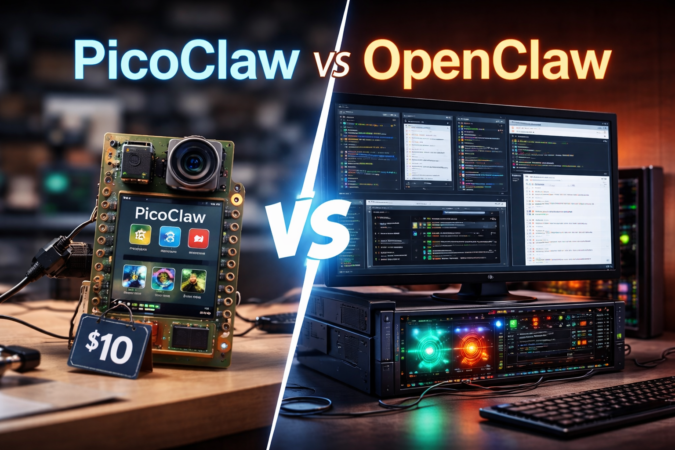
PicoClaw vs OpenClaw is quickly becoming one of the most discussed topics in AI right now, as a lightweight agent challenges a powerful but resource-heavy system.
For months, OpenClaw has been seen as one of the most exciting developments in personal AI. It introduced the idea of autonomous agents that could manage tasks, automate workflows, and interact across platforms—all while running locally.
However, a new contender—PicoClaw—is changing how people think about AI agents entirely.
What Is OpenClaw?
OpenClaw is a local AI agent designed to act like a digital assistant on your system.
It can:
- Manage emails and schedules
- Automate browser tasks
- Execute commands
- Maintain memory across sessions
Because it runs locally, it offers better privacy compared to cloud-based tools. Developers quickly adopted it due to its flexibility and powerful features.
However, OpenClaw comes with practical limitations.
Limitations of OpenClaw
Despite its capabilities, OpenClaw requires relatively strong hardware to run efficiently.
- Around 1–4 GB RAM needed
- Startup time can take several minutes
- Requires desktop or server-level systems
As a result, it cannot run effectively on:
- Low-cost IoT devices
- Embedded systems
- Battery-powered hardware
This makes large-scale deployment difficult.
What Is PicoClaw?
PicoClaw is a lightweight AI agent built from scratch with a focus on efficiency and accessibility.
Instead of improving OpenClaw step by step, it rethinks the entire system architecture. The result is a much smaller and faster AI agent that can run almost anywhere.
PicoClaw vs OpenClaw: Key Differences
Here is a clear comparison of PicoClaw vs OpenClaw:
| Feature | OpenClaw | PicoClaw |
|---|---|---|
| Memory Usage | 1–4 GB+ | < 10 MB |
| Startup Time | Minutes | < 1 second |
| Hardware Needs | Desktop/server | Low-cost devices (~$10) |
| Deployment | Complex setup | Single executable file |
These improvements significantly reduce the barrier to entry for using AI agents.
Why PicoClaw Is Gaining Attention
The rise of PicoClaw is not just about better performance—it’s about new possibilities.
1. AI on Everyday Devices
PicoClaw can run on routers, cameras, and small embedded boards. This allows AI to exist in everyday hardware instead of just powerful machines.
2. Real-Time Local Processing
Tasks like monitoring or automation can be handled locally without sending data to the cloud.
3. Lower Cost of Deployment
Running on hardware as cheap as $10 makes it accessible to more users, including students and developers in emerging markets.
4. Faster Setup
With a single executable file, deployment becomes simple and quick.
PicoClaw vs OpenClaw: Which One Is Better?
The answer depends on the use case.
- OpenClaw is better for:
- Advanced workflows
- High-performance environments
- Developer-heavy setups
- PicoClaw is better for:
- Low-cost devices
- Edge computing
- Large-scale deployment
In reality, PicoClaw does not completely replace OpenClaw. Instead, it expands where AI agents can be used.
A Trend Most People Are Missing
One important detail stands out in the development of PicoClaw.
A large part of its architecture was generated using AI-assisted processes, with humans refining the output.
This highlights a bigger shift:
- AI is no longer just being used
- AI is now helping build new systems
As a result, development cycles are becoming faster and more efficient.
The Future of AI Agents
The comparison of PicoClaw vs OpenClaw reflects a broader change in the AI industry.
We are moving from:
- Cloud-based AI → Local AI
- Heavy systems → Lightweight systems
- Limited deployment → Scalable deployment
If this trend continues, AI agents could soon be embedded in everyday objects, from home devices to industrial systems.
Final Thoughts
OpenClaw proved that autonomous AI agents could work in real-world scenarios.
PicoClaw builds on that idea by making it more accessible, efficient, and scalable.
Together, they represent two stages of the same evolution—power and practicality.
❓ FAQs
What is PicoClaw?
PicoClaw is a lightweight AI agent that runs on low-cost hardware and performs automation tasks locally.
What is OpenClaw?
OpenClaw is a powerful local AI agent designed for advanced automation and multi-step task execution.
How is PicoClaw different from OpenClaw?
PicoClaw uses far less memory and hardware, making it suitable for small devices, while OpenClaw requires more powerful systems.
Can PicoClaw replace OpenClaw?
Not completely. PicoClaw expands AI usage to new environments, while OpenClaw remains useful for high-performance setups.
🔗 External Resource
Try PicoClaw yourself: https://github.com/sipeed/picoclaw