Artificial Intelligence has progressed at an astonishing speed over the last few years. In a short period of time, the world moved from simple chatbots and rule-based systems to powerful language models capable of writing code, solving complex problems, and assisting in research.
At first glance, it appears that many different companies are building very different AI systems. We hear about models from OpenAI, Google, Anthropic, Meta, and many others. Each new release is presented as a major leap forward. Every company claims that its model is better, smarter, faster, or more capable.
However, when we step back and examine the technical foundations behind these models, a surprising pattern emerges.
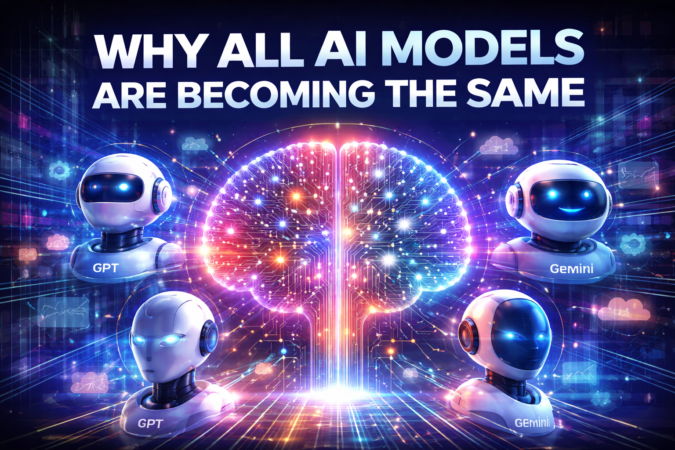
Despite the apparent competition, most modern AI models are not fundamentally different from each other. In fact, they are increasingly becoming variations of the same underlying system.
This convergence toward a single architecture is one of the most overlooked trends in the current AI era.
To understand why this is happening, we first need to look at how the modern generation of AI models began.
The Beginning of the Modern AI Era
The current generation of AI models can be traced back to a single research breakthrough in 2017. Before this point, most natural language processing systems relied heavily on recurrent neural networks (RNNs) and long short-term memory networks (LSTMs). These systems struggled with long sequences of text and were difficult to scale efficiently.
In 2017, researchers at Google published a paper titled “Attention Is All You Need.” This paper introduced a new architecture called the Transformer.
The key innovation of the transformer was the use of an attention mechanism. Instead of processing text sequentially, the model could examine all parts of a sentence simultaneously and determine which words were most relevant to each other.
This change might sound simple, but it dramatically improved the ability of models to understand language and scale to massive datasets.
Once the transformer architecture was introduced, it quickly became the foundation for nearly every major language model developed afterward.
The First Wave of Large Language Models
The next major milestone arrived in 2020 with the release of GPT-3.
GPT-3 demonstrated something that surprised many researchers: when a transformer model was trained at massive scale, it could perform tasks it had never explicitly been trained for. It could write essays, answer questions, generate code, and translate languages.
The model did not rely on traditional programming rules. Instead, it learned patterns directly from huge amounts of text.
This discovery led to the idea of large language models (LLMs).
Soon after, the AI industry entered an intense period of rapid development.
The Public AI Explosion in 2022
While GPT-3 was impressive, the real explosion of AI adoption happened in late 2022 with the release of ChatGPT.
For the first time, millions of people could directly interact with a powerful language model through a simple interface. ChatGPT quickly became one of the fastest-growing software products in history.
This moment triggered an industry-wide race. Almost every major technology company began investing heavily in AI research and large language models.
Over the next two years, several major model families appeared:
- OpenAI developed GPT-3.5, GPT-4, and later GPT-4-class models.
- Anthropic released the Claude series of models.
- Google introduced Gemini through its DeepMind division.
- Meta released the LLaMA family of open-source models.
- Several smaller labs introduced competitive models as well.
To the public, it looked like dozens of different AI systems competing with completely different approaches.
But beneath the surface, something interesting was happening.
The Hidden Similarity Between All Models
Although companies gave their models different names and branding, most of them share three core characteristics:
- They are built on the transformer architecture.
- They are trained on massive text datasets from the internet.
- They use a similar training process involving pretraining and human feedback.
In other words, most modern AI systems follow the same basic recipe.
The differences between models often come down to scale, optimization techniques, or training data quality rather than entirely new architectures.
This phenomenon is known as architectural convergence.
Instead of dozens of fundamentally different AI systems, the industry is slowly converging toward one dominant design.
How AI Models Are Evaluated
One reason the illusion of diversity persists is because companies compare models using benchmark scores.
Benchmarks are standardized tests designed to measure how well an AI model performs on certain tasks.
For example:
MMLU (Massive Multitask Language Understanding) tests knowledge across dozens of academic subjects including mathematics, law, physics, and medicine.
HumanEval measures a model’s ability to generate correct programming solutions.
GSM8K evaluates mathematical reasoning using grade-school level math problems.
When a new model is released, companies often publish benchmark results showing improvements over previous systems.
However, benchmarks do not always tell the full story.
The Benchmark Illusion
Benchmarks create the impression that each new model represents a fundamentally different intelligence.
But in reality, most improvements come from incremental changes rather than new ideas.
For example, a model might perform better because:
- It was trained on more data.
- It used more computing power.
- It had slightly improved optimization methods.
- It received additional reinforcement learning from human feedback.
These improvements matter, but they do not necessarily represent a new architecture.
As a result, benchmark scores often reflect scaling progress rather than conceptual breakthroughs.
The Scaling Strategy
Since the transformer architecture was introduced, the dominant strategy in AI development has been scaling.
Scaling involves increasing three key factors:
- Model size (number of parameters)
- Training data
- Computational power
Researchers discovered that when these factors increase together, model performance improves in a relatively predictable way.
This observation led to what researchers call scaling laws.
According to these laws, larger models trained on more data generally produce better results.
Because of this, most companies focus on building bigger and more powerful models rather than inventing entirely new architectures.
This reinforces the convergence effect.
The Role of Compute Power
Another reason models are becoming similar is the enormous cost of training frontier AI systems.
Training the largest language models requires thousands of high-performance GPUs running for weeks or months.
The cost can reach tens or even hundreds of millions of dollars.
Because of this, only a handful of organizations can realistically compete at the highest level.
These organizations often use similar infrastructure and optimization strategies.
The result is that their models evolve in very similar directions.
The Reinforcement Learning Layer
One important step in modern model training is reinforcement learning from human feedback (RLHF).
After the base model is trained on internet text, human reviewers evaluate the model’s responses and guide it toward preferred behavior.
This process improves usefulness, safety, and conversational ability.
However, because many companies use similar reinforcement learning methods, their models also develop similar personalities and response patterns.
This is another reason why interacting with different AI assistants often feels surprisingly familiar.
The Open-Source Influence
Open-source models have also contributed to the convergence effect.
When companies release model architectures, research papers, and training techniques publicly, other organizations quickly adopt and refine those methods.
This accelerates innovation but also encourages standardization.
As a result, many research labs build models that closely resemble each other.
Are All Models Truly the Same?
Despite these similarities, it would be inaccurate to say that all AI models are identical.
There are still meaningful differences between them.
Some models are optimized for coding tasks, while others focus on reasoning or multimodal capabilities such as images and audio.
Certain companies prioritize safety and alignment more heavily than others.
However, the underlying architecture powering these models is largely the same.
This suggests that the AI industry may currently be in a phase similar to the early days of aviation or computing, where one dominant design begins to emerge.
What This Means for the Future
If all models continue to rely on the transformer architecture, future progress may depend more on scaling and engineering improvements than on entirely new ideas.
However, this also raises an important question.
Will the transformer architecture remain dominant forever?
Or will a new breakthrough eventually replace it?
History suggests that dominant technologies rarely last indefinitely.
Just as neural networks replaced earlier AI systems, a new architecture could eventually surpass transformers.
Researchers are already exploring alternatives, including hybrid systems that combine language models with reasoning engines or symbolic computation.
If such a breakthrough occurs, it could trigger another major shift in the AI landscape.
The Real Competition in AI
While companies compete publicly through model releases and benchmark scores, the deeper competition may actually revolve around three factors:
- Access to computing power
- Quality of training data
- Efficiency of scaling techniques
These factors determine how far a model can be pushed within the transformer framework.
In other words, the real race is not necessarily about inventing entirely different AI systems, but about pushing the same architecture further than anyone else.
Conclusion
The modern AI revolution has produced a wide range of powerful models from different organizations around the world.
At first glance, these models appear to represent entirely different approaches to artificial intelligence.
But a closer examination reveals a surprising reality.
Most of today’s leading AI systems share the same fundamental architecture, the same training strategies, and many of the same evaluation benchmarks.
Rather than diverging into radically different designs, the industry is gradually converging toward a single dominant model structure.
This convergence does not mean innovation has stopped. On the contrary, the pace of improvement remains incredibly fast.
However, much of that progress comes from scaling, optimization, and engineering rather than completely new architectures.
Understanding this trend provides a clearer view of the current AI landscape and may help explain where the next breakthroughs are likely to come from.
Whether the transformer architecture remains dominant or eventually gives way to a new paradigm will be one of the most important questions shaping the future of artificial intelligence.